Off to DL…

We’ve been busy preparing talks and posters for the Description Logics workshop 2011 in Barcelona, which will start on Wednesday 13th July. I’m really looking forward to meeting researchers from the DL community and to hearing some interesting talks! The workshop program is packed with talks and presentations, so I’m sure there will be plenty to discuss.

The Manchester group will be present with two posters (Samantha Bail, Bijan Parsia and Ulrike Sattler. ‘Extracting Finite Sets of Entailments from OWL Ontologies’ and Chiara Del Vescovo. The Modular Structure of an Ontology: Atomic Decomposition with Labels’) and two talks (Matthew Horridge, Samantha Bail, Bijan Parsia and Ulrike Sattler. ‘The Cognitive Complexity of OWL Justifications’ and Rafael S. Gonçalves, Bijan Parsia and Uli Sattler. ‘Analysing Multiple Versions of an Ontology: A Study of the NCI Thesaurus’).

I’m planning to write a short review of the workshop on this blog during / after my stay in Barcelona – the weather forecast looks pretty bad, so I presume I’ll have time in my hotel room to write quite a bit.

“Carlos Tevez hates Manchester more than you do.”

I just received an email with the above text and a link to a video of Carlos Tevez moaning about Manchester. It is pretty hilarious – the highlights are: “There’s nothing to do in Manchester […] it rains all the time, you can’t go anywhere!” and “I will not return to Manchester, not for vacation, not for anything.”

Bless.

Video clip is on the BBC website, clicketyclick the image to watch.

FYI, the caption says ‘I speak very bad English’. Tehehe.

Young Hearts Spark Fire: a night out in Fallowfield

Due to my being in possession of a Unirider, some people with, GASP, jobs, believe I am an unworthy creature whose life consists of staying up all night partying, destroying my house and annoying my neighbours*. Unfortunately, I’ve never had the pleasure of being an undergraduate student in this country and therefore cannot live up to these expectations – being a student is a much less excessive affair in Germany than it seems to be here. I usually try to get past the smelly boozers and dirty takeaways of Fallowfield as quickly as possible, since even shopping at the Sainsbury’s on my way home can be painful at times (Now repeat after me: pyjamas were never meant to be worn anywhere outside my house. A supermarket is not my house.).

But hey, this wouldn’t be mightaswell if I was just accepting the facts and avoiding Fallowfield by all means. Why not just go and live the student lifestyle myself – with a particularly classy night out in Fallowfield. The task: drink only the most fluorescent or silliest sounding drinks, eat stuff that doesn’t usually classify as edible in your life, stumble around in heels, make use of cheap booze offers, and spend not more than £20.

Having invested a considerate amount of time on my make-up and hair (you gotta do what you gotta do) I even decided to wear heels, which happens about twice a year and makes me regret every time that I wasn’t wearing ‘shoes for people with flat feet’, as I was told to. The night started with a romantic three course meal at McDonalds, yet another place which, as a vegetarian / part time vegan, secret hippie and general chain-refusenik, I have probably visited as many times as I have been seen wearing heels in my life. After some difficulties identifying the one vegetarian option on the menu, I settled for a ‘spicy veggie deli sandwich’ with fries and a banana milkshake. That’s three courses, right? (To anticipate the result, my night ended with a cup of peppermint tea and a hot water bottle on my belly.)

Feeling a little dirty and very disappointed with the semi-cold fries, we made our way into Fallowfieldia, the first stop being the local Wetherspoons. The pub was fairly unspectacular even for Wetherspoons standards, and after a pitcher of Woo Woo (silly name: tick!) which is basically just cranberry juice++, we moved on to Baa Bar. Here’s a confession: I don’t actually mind Baa Bar when it’s not busy. The drinks prices are fair, they’ve got German beer in bottles (makes me feel like home…), the insane shooter menu is fun, and the music is generally very quiet. I even suggested they could advertise with something like “Baa Bar – not shit until 9pm!”, but I’m not sure that was convincing enough. In the style of Baa Bar, I went for a bright green apple flavoured fizzy alcopop (fluorescent drink: tick!) and a few shooters with names like ‘Sassy Bitch’, ‘Dave’ (eh?), ‘Twilight’ and ‘Pinky Winky’ (silly names: tick! tick! tick! tick!). Our visit to the rather quiet Baa Bar was followed by a quick stop at the Tesco’s next door to buy a box of Rennie. You gotta do etc.

Moving further up Wilmslow Road, we headed for a quick drink and a game of pool at the Cheshire Cat, where we encountered a person sleeping on the sofa, the bar staff playing ‘catch the peanut with your mouth’, drinks smashing on the floor, and someone being sick all over the sinks in the gents toilets. (I’ve got pictures of the toilet incident, but I think posting these would be one step too far, even for me.) It was also the first time I heard Bjork’s ‘I miss you’ in a bar. Lovely place.

A fairly recent but very clever addition to the watering holes in Fallowfield is the second branch of the beloved cheap as chips cocktail (””cocktail””) bar Font. Sticky tables and unnecessarily loud music are as much a part of Font, as are huge queues at the bar and toilets that were obviously bought from the hellhole store (ok, I stole that one from Das Racist). Nonetheless, we decided to savour some of their delicacies on the cocktail (””cocktail””) menu and ended up bumping into someone we least expected there: people my age. My mates were probably as surprised as I was to meet them there, but the instant ‘we’re in this together now’ feeling convinced us to stay, despite the painfully loud music that reduced my vocal chords to shrivelled up parcel twine.

After only two cocktails (””cocktails””) however, the accumulation of fluorescent drinks, greasy junk food and shooters with silly names cut a hole in my stomach and therefore the evening fairly short. All my plans to end the night with a little dance at Robinskis or the Revolution’s UV party of the year were annihilated. I admitted defeat and went home.

So, how was it? Well. Fallowfield was rather quiet due to it being the end of term time, and therefore rather uninteresting. I got away spending a minimum on drinks, I saw some appalling toilets and got stuck on dirty tables a few times. It wasn’t nearly as bad as I had expected, but hey, I’ll be back in Fresher’s Week to get the full Fallowfield experience.

Did I just write a 900 word blog post about going out for drinks? Hell yes I did.

* Hint: Having a 9-5 job doesn’t make you a better person.

Reactions to schema.org

Last week schema.org was launched, which started a fairly active discussion on the semantic-web W3C mailing list. The three major search engine providers, Google, Bing and Yahoo, teamed up to produce the website, which they describe as “a joint effort […] to improve the web by creating a structured data markup schema supported by major search engines.” [1]

What is it?

The main contribution of the platform is a set of schemas manifested as a simple vocabulary which contains entities (or “Types”) such as Event, Person, Place, Product, etc., and the respective sub-entities (“more specific types”). The technology chosen for this approach is the HTML Microdata format (currently a W3C working draft), which introduces a handful of HTML attributes that can be added to standard HTML tags such as span and div. The most prevalent ones are itemscope and itemtype, which indicate that our HTML element starts a new “item” of a particular type (e.g. itemtype=”http://schema.org/Book”) , and itemprop, whose values specify what it is we’re enclosing with the element, i.e. the properties of the item (e.g. itemprop=”name”). And this is where schema.org comes into play: the types ‘defined’ (the terms aren’t defined in the semantic sense, as the vocabulary follows a simple hierarchical ‘is-a’ tree structure) in their vocabulary can be conveniently used to fill in the values for itemtype and itemprop.

Reactions

And, schema.org being about the web and on the web, the SemWeb community responded quickly. Here are some of the reactions that started active discussions in their comment sections:

  • Michael Bergman’s has posted a rather elaborate and enthusiastic article on his blog, focusing mainly on the benefits of a shared vocabulary and the advocation of the straightforward Microdata format (as opposed to RDFa) to further the ‘Structured Web’: “Google and the search engine triumvirate understand well — much better than many of the researchers and academics that dominate mailing list discussions — that use and adoption trump elegance and sophistication.”
  • Adrian Gschwend wrote a slightly more critical post, explaining why he sees neglecting RDFa as a mistake, and criticizing the top down approach of schema.org: “If you are strong in a specific domain, you should create the vocabulary for it, not some experts at Google/Yahoo/Bing which try to figure out how they can squeeze the whole universe in 300 or so tags.
  • Manu Sporny, chair of the RDFa working group, has titled his review ‘The False Choice of schema.org’, claiming that “the freedom of choice on the web is being threatened”. The post has also attracted a large number of commenters.
  • Benjamin Nowack summarises some of the reactions on his blog and considers schema.org to be a “nice starting point” for the Semantic Web.
  • schema.rdfs.org was started (looking suspiciously like schema.org) as a “community project” to provide a mapping from the schema.org vocabulary types into different RDF formats.

So…?

I’m neither an enthusiastic SEO person, nor a pessimistic RDF advocate, so I’m keeping my comments to a few key issues: 1) From a very basic ‘all structure is good’ perspective, the schema.org approach to a shared vocabulary for the most common things on the internet is a good step away from the ‘web of documents’, regardless of the data format used. 2) I am, however, not particularly fond of the vagueness of the statements the site makes about extensions and use of other formats such as RDFa and Microformats – the documentation uses a lot of ‘ifs’, ‘mays’ and ‘coulds’. 3) I’m also uncomfortable about the ‘my way or the highway’ stance on other formats that has been discussed on other blogs. Of course, you don’t have to use schema.org and Microdata, but the search engines might not find you if you use something else (wink wink nudge nudge). 4) The vocabulary is extremely restricted and high-level – it will probably do the job for many things, but the dubious way of extending it (use your own types as sub-types of the existing ones and schema.org ‘may’ adopt it if the extension is used by enough people on the web) just makes it clear that this isn’t the place for community efforts. For now it seems that Google, Bing and Yahoo promise people that they can paint the rainbow if they use schema.org, but give them only a few grey and black pens (and if you go and buy some nice coloured ones, they’ll steal them back for their own pencil case…).

The bottom line: schema.org is just YAV – yet another vocabulary in a rather restricted and restrictive format, thrown in front of SEO-hungry ‘webmasters’ by, well, search engine companies. A handful of terms in a tree, no relations, no definitions for the types – in a word (or three), it’s boring, boring, boring. There’s no need to go crazy about it or call it the end of the Semantic Web as we know it. I’d much rather focus on the more exciting, highly expressive formats that provide a platform for complex modelling and let me say things like “a Riesling is a wine with a white colour which is made from only one grape which is a Riesling grape”, with all its implications.

[1] http://schema.org/docs/faq.html#0

Axiomatic Richness – is your ontology full fat or skimmed?

The term ‘axiomatic richness’ is used in various places to talk about a certain property of an OWL ontology, mostly meaning ‘how much do we say about a particular concept’. Axiomatically rich ontologies are in some way considered better and more interesting than axiomatically lean ones. There is, however, no clear definition of the term. A quick google search for ‘axiomatic richness’ throws up only a few distinct sources that attempt to answer the question ‘what makes an (OWL) ontology axiomatically rich?’. In what follows, I discuss some of the main points of the papers and blog posts I have found.

‘Possibility of Deriving Inferences’

Robert Stevens and Sean Bechhofer discuss the term in their post on the OntoGenesis blog:

The axiomatic richness of an [ontology] refers to the level of axiomatisation that is present. […] A lack of axiomatic richness limits the possibility of deriving inferences from an [ontology]. […] Axiomatic richness could be measured in a number of ways. Hayes for example, in the Naive Physics Manifesto, discusses density. […]

(from http://ontogenesis.knowledgeblog.org/257, 2010)

It also states that in order to be axiomatically rich, the information in the ontology has to be “in a form amenable to machine processing”; plain text descriptions, such as in a SKOS vocabulary, are not sufficient.

This states that axiomatic richness is somehow related to the inferential potential in the ontology, but doesn’t give any further hints as to how we can measure axiomatic richness, or how we can tell whether ontology A is ‘richer’ than ontology B.

‘Large Number of Justifications’

Further down the list of search results, I happened to stumble across my own paper about the Justificatory Structure of OWL ontologies (OWLED 2010), where I state that

[…] taxonomic ontologies containing only trivial axioms of the form (A SubClassOf: B) are commonly regarded as axiomatically weak. A simple indicator for axiomatic richness could be a large average number of justications for entailments.

(from http://owl.cs.manchester.ac.uk/explanation/owled2010/JustStructure_OWLED2010.pdf, 2010)

“Could be” – nothing definitive here either. Many justifications (on average) for the entailments in the ontology simply means that there are many reasons why a certain entailment holds (entailment in the sense of asserted and inferred axioms that satisfy the entailment relationship with the ontology – blog post on this issue to follow soon, potentially including and discussing reviews from my DL workshop paper). While this might be an indicator of redundancy in the ontology (for which we haven’t got a definition either), the number of justifications alone doesn’t tell us much about how much we say about a particular concept, which is usually the focus when talking about axiomatic richness.

We could probably extend this guess to say “a concept A is axiomatically rich if there are 1) many justifications for 2) entailments of the form A SubClassOf B or EquivalentClasses(A,B)”, i.e. entailments that somehow define the concept. (Counter) examples might follow.

Using ‘Expressive’ Constructors

Mikel Egana Aranguren‘s thesis is a rich (haha) source of information about axiomatic richness. I found this quote quite interesting:

The OWL version of the Gene Ontology […] is implemented exploiting a rigorous formalism (OWL), but a limited fragment of the expressivity of OWL is used in axioms. On the other hand, the OBO version of the Sequence Ontology […] is axiomatically rich (e.g. symmetric properties and intersections of classes can be found in the ontology).

(from http://www.sindominio.net/~pik/thesis.pdf, 2009)

He also claims that “bio-ontologies represent biological knowledge in a limited, lean and not rigorous manner”.

A similar assumption is made in Martin Hepp’s description of “A Methodology for Deriving OWL Ontologies from Products and Services Categorization Standards”

[…] the semantic richness needed for most business scenarios will come from the usage of the huge collection of properties.

(from http://is2.lse.ac.uk/asp/aspecis/20050152.pdf, 2005)

Well. I see the point in this argument (similar to the one I made above, i.e. we can’t really say much if we only use atomic subsumptions in our ontology), but I disagree with the statement that expressivity=axiomatic richness. In many of our experiments, we have found that expressivity doesn’t really tell us much about how ‘complex’ the ontology is – reasoner performance, number and size of justifications, etc., do not correlate with the types of constructors found in the ontology (to a certain extent, obviously). Just using the constructors in some way to define a concept doesn’t necessarily make the ontology ‘richer’. Trust me, Son, I’ve seen some of those allegedly weak EL++ ontologies that could have made “the strongest man on earth whimper like a frightened kitten”.

Ontology Design Patterns

Robert Stevens and Mikel Egana Aranguren mention the term again in their paper “Applying Ontology Design Patterns in Bio-Ontologies”. They claim that Ontology Design Patterns (ODP)

[…] have already brought benefits in terms of axiomatic richness and maintainability […]

(from http://www.springerlink.com/content/d2lp476v0p281q73, 2008)

They refer to two more papers dealing with ODP in bio-ontologies, which I won’t cover here.

Locality Based Modules (LBM)

My (current and past) office neighbour Chiara Del Vescovo and Thomas Schneider drop a hint at defining axiomatic richness in a WoMo workshop talk:

[…] extract all (relevant) LBMs in order to […] draw conclusions on characteristics of an ontology:[…] What is the axiomatic richness of O?

(from http://www.informatik.uni-bremen.de/~ts/talks/1005_dl+womo.pdf, 2010)

Unfortunately, the slides don’t go into detail, and I don’t remember any discussions from the talk, so I can’t say much about this.

Non-Trivial Entailments

Yet another explanation from Manchester can be found in Pavel Klinov’s and Bijan Parsia’s paper on “Implementing an Efficient SAT Solver for Probabilistic DL“:

For axiomatically weak TBoxes, where almost all subsumptions can be discovered by traversing the concept hierarchy […]. More complex TBoxes may have non-trivial entailments involving concept expressions on both left-hand and right-hand sides […]

(from http://www4.in.tum.de/~schulz/PAPERS/STS-IWIL-2010.pdf, 2010)

To clarify, I assume the ‘non-trivial entailments’ means subsumptions that are inferred, not asserted, whose justifications involve GCIs. This sounds similar to my statement above about ‘many complex’ justifications for entailments.

Conclusion

Scio me nihil scire. I do however quite like the idea of relating axiomatic richness to the number and type of reasons (i.e. justifications) I have for an (some, all?) entailment of the ontology. We could certainly use some formal definition (or multiple, depending on which aspect is most relevant to the developer, the domain, the application…) which allows us to think of the same things when talking about ‘axiomatic richness’ and comparing ontologies. To be continued…

Jesus Fucking Christ.

I usually don’t post news here, as there are many other sites that do it so much better, but this one got me quite upset. Only today it was reported that Wythenshawe Park, which I wrote about last year, was the target of some shockingly sick vandalism. Some time on Sunday evening / Sunday night, they broke into the aviary located in the park, beheaded 18 birds (seriously, what the fuck?), threw them around, poisoned a carp in a pond with fertiliser, chopped down trees and smashed windows, causing more than £10,000 of damage, according to the BBC.

One way to spend your bank holiday weekend, I suppose.

The BBC has some more details on the case, and the police (0161 856 4546) and Crimestoppers (0800 555 111) ask anyone who has any information to come forward.

Giant chicken will come and get you. Yes, you.

The Semantic Web Layer Cake

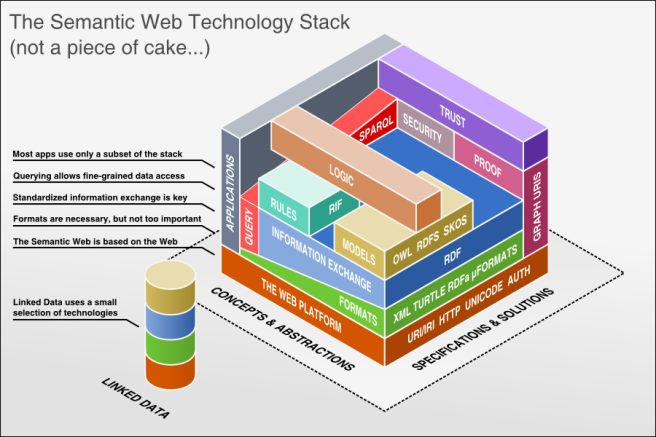
I just came across this 3-dimensional representation of the Semantic Web Layer Stack – or cake-  handcrafted by Benjamin Nowack. The author also links to Jim Hendler’s talk on the Semantic Web Layercake (from 2009), possible the world’s first Semantic Web talk completely in rhyme. Jim’s talk gives a good overview of the evolution of the Semantic Web and how an incredible number of icing, sprinkles and candles was added to the layercake over the years.

semantic_web_technology_stack

The complexity of the stack – both the ‘simplified’ version and the more elaborate one in Jim’s talk – makes me wonder how usable the Semantic Web approach really is. Will there be a point where the technologies converge, some die, others emerge as winners? Or will we live happily with a big messy cake that’s got a little something for everyone?

(via http://mikeleganaaranguren.wordpress.com/2011/03/11/semantic-web-layer-cake-3d/)

Running Off With The Fun City Girls: The Great Manchester Run 2011

Okay, here’s the deal: I run 10 kilometres, you give me loads of money for that, which I then give to a charity of my choice. That makes sense, right? Wait, what do you mean, what’s the point of me running at all? Well, it’s… you know… oh just give me the money already, will you!

Sponsored charity runs are a completely alien concept to Germans. I had to explain the idea to my family several times, mumbling something about ‘challenge’ (“Why? You run all the time anyway don’t you? What’s the challenge in that? And why should we give you our money?”) until I finally resorted to the ‘give me your money and you’ll be on my wall of fame’ trick.

I signed up for the Manchester 10k run in January and started training quite enthusiastically…for about a week. Then I realised that 10k wouldn’t be a big deal anyway and went back to doing my usual runs round the block and in the park. I forgot about it completely for a while until about a week ago when I was planning the upcoming weekend and started to panic: I won’t be able to make it. I’ll get really ill before the run. We’ll be late. I’ll oversleep. I’ll have to go to the loo every five minutes. There will be torrential rainfalls. We won’t be able to park anywhere. I’ll pass out for no reason.

Fortunately, the mighty Jogger Swan King took me under his wings, and the whole ‘I’m going to run 10k as fast as I can’ affair turned into ‘we’ll run 10k with a guy in a 7 ft swan costume and have fun’. Our team partner Dr Maha was suffering from an ankle injury, so we decided to take it easy on the day. Dressed up as the Swan King’s hipster bodyguards (think Bjorn Borg ca 1975 meets Michael Cera in Juno meets the 118 118 guys), sporting hot pants, white socks and co-ordinated ponytails (mine left, Dr Maha’s right), we rolled up to the great event in the loveliest Manchester weather: freezing cold, drizzly rain, icy wind.

After the much needed warm-up with Mr Motivator*, the guns went off and we embarked on a leisurely jog joining 40.000 other runners, down Portland Street, then Chester Street, to the Man United ground, and back up along Deansgate, to the finish right in front of the Hilton. Here’s the highlights of the day:

  • At km 1 I realised I needed the loo.
  • At km 2 we whooped for at a runner wearing a giant giraffe costume and the Swan King high-fived loads of kids.
  • At km 3 we had our first ankle-pain-induced walking break.
  • At km 4 we went past a band playing ‘Chariots of Fire’ by Vangelis (click the link and you know the song!), pretending we were running in slow motion.
  • At km 5 we started swearing at people on the side who were eating chips.
  • At km 6 we stopped for a little dance to the Stone Roses in front of Clint Boon’s stage.
  • At km 7 we yelled the Super Mario Bros theme tune at two runners dressed as Mario and Luigi.
  • At km 8 the Jogger Swan King had a little jig with the dixie band. I also finally found the loos.
  • At km 9 I got utterly confused because people were shouting my name at me, until I realised that it was written on the race number on my chest.
  • At the finishing line the announcer praised the Swan King, mentioned my name, we high-fived and collected our medals and goodie bags from the army.

Oh, what fun we had. If you see someone walking round Manchester with a medal round their neck, that would be me.

I raised an okayish £333, Mr Swan King managed around £500, both for the Red Cross, who welcomed us in the Charity Village with bananas, crisps, iced tea, mini mars bars and custard creams worthy of a children’s birthday party. (THANKS TO EVERYONE WHO DONATED, YOU’RE SUPER AWESOME!)

Due to tiredness I’m actually lacking sarcasm, so here’s my completely honest and filthy cliche conclusion: despite the weather, the atmosphere at the run was great, the other runners were nice, and we really enjoyed it. And OHMYGODIWANTTODOITAGAIN.NOW!

Next year. Next year. And I’ll up the fancy dress. Oh yes.

* It wasn’t Mr Motivator, but I really wished it was.

brb science.

I’ve been busy doing groundbreaking research, training for the Manchester 10k run and playing with Gethin in the past couple of weeks, please excuse the lack of posts. Normal services will be resumed next week.

Here’s a few rabbit action shots to cheer you up. You know you want it.

Bunny likes to climb things. And people.

We tricked him into posing with some cherry blossoms for Easter cards by pretending they were tasty. He totally fell for it. Ha!

One day, his nosiness will get him into trouble.

Tug tug tug nip nip pull pull tug bite bite chew bite lick tug tug tug tug nip nip.

The fact that something is on the floor which usually isn’t on the floor gets the bunny madly excited. ‘Dude…it’s…it’s a backpack! On the FLOOR! How crazy is that, man?’

Is it just me or does he look like a guinea pig/horse/cat crossbreed sometimes?

Paws and slippers.

I sowed some cress in a plastic tub, as a present to him on Easter Sunday. He had a little nibble, probably just out of politeness, then went back to destroying our furniture. Ah well.

All Across the Sands: And then, then we went to Wales.

Escape, escape.

I don’t know what happened in Wales during the last few ice ages, but it must have been pretty intense. The west coast of Wales pretty much consists of hills, mountains, mountain-like hills, rivers, lakes, estuaries, and sheep. I presume the sheep came after the ice age (who knows…), but everything else looks like it has been scrunched up and folded and squeezed and punched by incredibly powerful giant ice masses. This is also what I imagine the Welsh did with their language – scrunch the words, fold and squeeze them, add a few ls and ys and ds here and there to make it completely illegible.

I went to Snowdon last year, which, while certainly offering a decent walk in surprisingly nice weather, was rather unimpressive. This time we staying for a weekend, exploring the area around Barmouth (Abermaw in Welsh) and climbing Cadair Idris, which is Wales’ second most popular mountain. Well, ‘mountain’. To summarise the weekend: I ate honey ice cream, and saw sheep, and drank ale, and saw sheep, and went up on a hill, and saw sheep, and watched the sun set over the sea while drinking cider, and saw sheep, and learned Welsh, and saw sheep, and had pie and chips, and saw sheep, and went to Happy Valley, and saw sheep, and played with frog spawn, and saw sheep. I loved it!

I’ve been putting off this post for a week because I’ve not been feeling particularly chatty, but the pictures are really nice, so please enjoy the ensuing silence and look at some pretty photos while I’m gathering strength for a first class rant. Or a rabbit post. Or a ranty rabbit post.