Reading material: “Interactive ontology revision”

This is the second in a series of blog posts on “interesting explanation/debugging papers I have found in the past few months and that I think are worth sharing”. I’m quite good with catchy titles!

Nikitina, N., Rudolph, S., Glimm, B.: Interactive ontology revision. J. Web Sem. 12: 118-130 (2012) [PDF]

This paper follows a semi-automated approach to ontology repair/revision, with a focus on factually incorrect statements rather than logical errors. In the ontology revision process, a domain experts inspects the set of ontology axioms, then decides whether the axiom is correct (should be accepted) or incorrect (axiom is rejected). Each decision thereby has consequences for other axioms, as they can be either automatically accepted (if they follow logically from the accepted axioms) or rejected (if they violate the accepted axioms). Rather than showing the axioms in random order, the proposed system determines the impact a decision has on the remainder of the axioms (using some ranking function), and gives higher priority to high impact items in order to minimize the number of decisions a user has to make in the revision process. This process is quite similar to Baris Sertkaya’s FCA-based ontology completion approach, which employs the same “accept/decline” strategy.

The authors also introduce “decision spaces”, a data structure which stores the results of reasoning over a set of axioms if an axiom is accepted or declined; using this auxiliary structure saves frequent invocation of a reasoner (83% of reasoner calls were avoided in the revision tool evaluation). Interestingly, this concept on its own would make for a good addition to OWL tools for users who have stated that they would like a kind of preview to “see what happens if they add, remove or modify an axiom” while avoiding expensive reasoning.

1-s2-0-s1570826811001028-gr3

Conceptually, this approach is elegant, straightforward, and easily understandable for a user: See an axiom, make a yes/no decision, repeat, eventually obtain a “correct” ontology. In particular, I think it the key strengths are that 1) a human user makes decisions whether something is correct or not, 2) these decisions are as easy as possible (a simple yes/no), and 3) the tool (shown in the screenshot above) reduces workload (both in terms of “click count” as well as cognitive effort, see 2)) for the user. In order to debug unwanted entailments, e.g. unsatisfiable classes, the set of unwanted consequences can be initialised with those “errors”. The accept/decline decisions are then made in order to remove those axioms which lead to the unwanted entailments.

On the other hand, there are a few problems I see with using this method for debugging: First, the user has no control over which axioms to remove or modify in order to repair the unwanted entailments; in some way this is quite similar to automated repair strategies. Second, I don’t think there can be any way of the user actually understanding why an entailment holds as they don’t get to see the “full picture”, but only one axiom after another. And third, using the revision technique throughout the development process, starting with a small ontology, may be doable, but debugging large numbers of errors (for example after conversion from some other format into OWL or integrating some other ontology) seems quite tedious.

Dog Food Conferences

Via the @EKAW2012 Twitter account I just landed on the “conferences” list on semanticweb.org. Since 2007, the conference metadata of several web/semweb conferences (WWW, ISWC, ESWC…) has been published as linked data, including the accepted publications (with abstract, authors, keywords, etc) and list of invited authors. Check out the node for my ISWC 2011 paper, for example.

I’m quite tempted to experiment with this and generate some meta-meta-data. Do you know of any applications using these data, or have you got any ideas what to do with it?

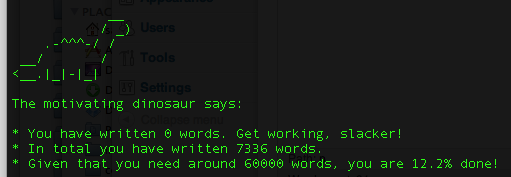
Semi-productive procrastination: The LaTeX motivator.

screen-shot-2012-09-28-at-15-53-57

Two things that might be relevant for understanding what I did here:

  1. I’ve recently started learning Python and I love it, thus try to write as much code as possible in Python.
  2. I’ve also recently started writing my thesis, and I try to write as much as possible.

Voila, the “LaTeX motivator” script is born (based on a version by my supervisor… but mine has special effects). Download it off github, copy the scripts (.py plus the .pl wordcount script) into the directory with your tex files, run latex-motivator.py, select your favourite motivating animal, and off you go. Now all you have to do is write a thesis. Easy!

Update: It seems that the stats.csv output is a bit broken. Will fix once I’ve written enough to make the dino happy.

Reading material: “Direct computation of diagnoses for ontology debugging.”

After my excursion into the world of triple stores, I’m back with my core research topic, which is explanation for entailments of OWL ontologies for the purpose of ontology debugging and quality assurance. Justifications have been the most significant approach to OWL explanation in the past few years, and, as far as I can tell, the only approach that was actually implemented and used in OWL tools. The main focus of research surrounding justifications has been on improving the performance of computing all justifications for a given entailment, while the question of “what happens after the justifications have been computed” seems to have been neglected, bar Matthew Horridge’s extensive work on laconic and precise justifications, justification-oriented proofs, and later the experiments on the cognitive complexity of justifications. Having said that, in the past few months I have come across a handful of papers which cover some interesting new(ish) approaches to debugging and repair of OWL entailments. As a memory aid for myself and as a summary for the interested but time-pressed reader, I’m going to review some of these papers in the next few posts, starting with:

Shchekotykhin, K., Friedrich, G., Fleiss, P., Rodler, P.: Direct computation of diagnoses for ontology debugging. arXiv 1–16 (2012) [PDF]

The approach presented in this paper is directly related to justifications, but rather than computing the set of justifications for an entailments which is then repaired by repairing or modifying a minimal hitting set of those justificationsthe diagnoses (i.e. minimal hitting sets) are computed directly. The authors argue that justification-based debugging is feasible for small numbers of conflicts in an ontology, whereas large numbers of conflicts and potentially diagnoses pose a computational challenge. The problem description is quite obvious: For a given set of justifications, there can be multiple minimal hitting sets, which means that the ontology developer has to make a decision which set to choose in order to obtain a good repair.

Minor digression: What is a “good” repair?

“Good repair” is an interesting topic anyway. Just to clarify the terminology, by repair for a set of entailments E we mean a subset R of an ontology O s.t. the entailments in E do not hold in O R; this set R has to be a hitting set of the set of all justifications for  E. Most work on justifications generally assumes that a minimal repair, i.e. a minimal number of axioms, is a desirable repair; such a repair would involve high power axioms, i.e. axioms which occur in a large number of justifications for the given entailment or set of entailments. Some also consider the impact of a repair, i.e. the number of relevant entailments not in E that get lost when modifying or removing the axioms in the repair; a good repair then has to strike a balance between minimal size and minimal impact.

Having said that, we can certainly think of  a situation where a set of justifications share a single axiom, i.e. they have a hitting set of size 1, while the actual “errors” are caused by other “incorrect” axioms within the justifications. Of course, removing this one axiom would be a minimal repair (and potentially also minimal impact), but the actual incorrect axioms would still be in the ontology – worse even, the correct ones would have been removed instead. The minimality of a repair matters as far as users are concerned, as they should only have to inspect as few axioms as possible, yet, as we have just seen, user effort might have to be increased in order to find a repair which preserves content, which seems to have higher priority (although I like to refer to the anecdotal evidence of users “ripping out” parts of an ontology in order to remove errors, and some expert systems literature which says that users prefer an “acceptable, but quick” solution over an ideal one!). Metrics such as cardinality and impact can only be guidelines, while the final decision as to what is correct and incorrect wrt the domain knowledge has to be made by a user. Thus, we can say that a “good” repair is a repair which preserves as much wanted information as possible while removing all unwanted information, but at the same time requiring as little user effort (i.e. axioms to inspect) as possible. One strategy for finding such a repair while taking into account other wanted and unwanted entailments would be diagnoses discrimination, which is described below.

Now, back to the paper.

In addition to the ontology axioms and the computed conflicts, the user also specifies a background knowledge (those axioms which are guaranteed to be correct), and sets of positive (P) and negative (N) test cases, such that the resulting ontology O entails all axioms in P and does not entail the axioms in N (an “error” in O is either incoherence/inconsistency, or entailment of an arbitrary axiom in N, i.e. the approach is not restricted to logical errors). Diagnoses discrimination (dd) makes use of the fact that different repairs can have different effects on an ontology, i.e. removing repair R1 and R2 would lead to O1 and O2, respectively, which may have different entailments. A dd strategy would be to ask a user whether the different entailments* of O1 and O2 are wanted or unwanted, which leads to the entailments being added to the set P or N. Based on whether the entailments of O1 or O2 are considered wanted, repair R1 or R2 can be applied.

With this in mind, the debugging framework uses an algorithm to directly compute minimal diagnoses rather than the justifications (conflict sets). The resulting debugging strategy leads to a set of diagnoses which do not differ wrt the entailments in the respective repaired ontologies, which are then presented to the user. When taking into account the set of wanted and unwanted entailments P and N, rather than just presenting a diagnosis without context, this approach seems fairly appealing for interactive ontology debugging, in particular given the improved performance compared to justification-based approaches. On the other hand, while justifications require more “effort” in comparison than being presented directly with a diagnosis, they also give a deeper insight into the structure of an ontology. In my work on the “justificatory structure” of ontologies, I have found that there exist relationships between justifications (e.g. overlaps of size >1, structural similarity) which add an additional layer of information to an ontology. We can say that they not only help repairing an ontology, but also potentially support the user’s understanding of it (which, in turn, might lead to more competence and confidence in the debugging process).

* I presume this is always based on some specification for a finite entailment set here, e.g. atomic subsumptions.

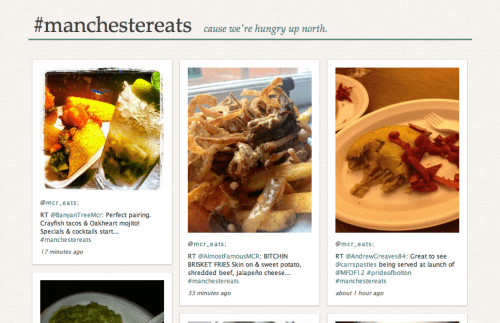
#manchestereats. Cause we’re hungry up North!

So, you know I do computery stuff for a day job.* And I genuinely enjoy doing computery stuff in my spare time, too. Long story short: I played with the Twitter API and jQuery and out came manchestereats.com – a site which does what you all love: Show pretty pictures of tasty food. Think Pinterest for food in Manchester. A very specific Pinterest. Some might even call it pointless. Oh, whatever. Go on the Twitters, tweet your breakfast/lunch/dinner/snacks with the hashtag #manchestereats (or #mcreats if you prefer it shorter), then go and drool over manchestereats.com.

 * Job = I get EPSRC money for writing hundreds of pages of text which no more than 3 people (examiner 1, examiner 2, and both supervisors to an approximated 50%) in the world will ever read, but hey ho.

A few of my favourite things

So, I got caught up in a torrential rain storm on my way home last night, and, having screamed at the rain all the way while cycling down Oxford Road, I did the only reasonable thing and sought shelter at Big Hands. As I was trying to get a little dryer (by sitting on bench… I know, good story, right?) I started chatting to some Australian girls who had been in Manchester for a few weeks. I kept asking which places they had been to and ended up jotting down a list of my favourite spots to visit in Manchester. I couldn’t help but turn this into a blog post,* so there you go:

Central

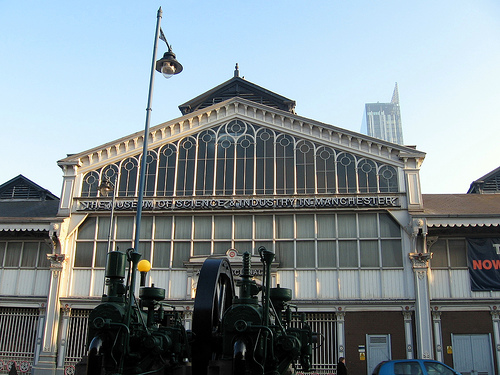
Museum of Science and Industry (MOSI)

Oh, how I love this place. Whether it’s for a full tour round the different exhibitions (which can easily take you half a day), or just for a sneaky visit to the absolutely magnificent steam engine hall, MOSI is one of my staples to take visitors to. If you’re lucky, the steam engines are running, and you can spend quite some time just marvelling at these fantastic pieces of engineering, with their bolts and pistons moving to what seems like a perfectly choreographed little dance. Well, I do.

The Knott

This pub, just round the corner from MOSI, offers some of the tastiest pub grub in town. They used to have a grilled halloumi sandwich which was so good, it made me weep (I do get very emotional when eating nice veggie food); the Lancashire cheese and beet root pie (if that’s your kind of thing), however, has now become my new favourite.

Cloud 23

While I find Cloud 23 as a bar rather unattractive, it’s definitely worth a visit for the Afternoon Tea (or, aptly named, “High Tea”). Watch Manchester from above while eating cake – winner.

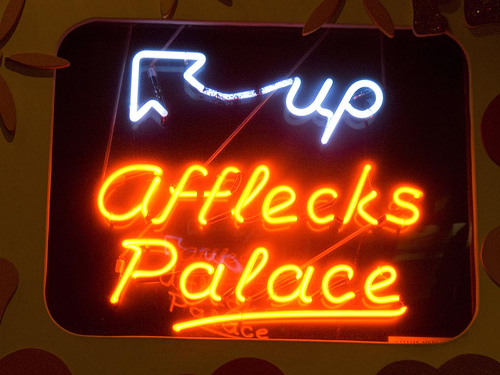
Affleck’s Palace

It seems every Mancunian has a story of how they used to hang out at Affleck’s in their teens. This indie shopping mall is a huge maze of little shops spanning several floors, ranging from second hand to fancy dress, posters and badges, hand-made jewellery, and general weird stuff. There’s a tasty little milk shake bar hidden in some corner on the 1st floor (maybe… I tend to lose my bearings as soon as I enter the building), a cafe on the top floor, and endless hours of fun.

The Star & Garter

When I first moved to Manchester, I spent many a Saturday night dancing at Smile, “Manchester’s longest running indie night” at the Star&Garter pub. While the novelty of drinking double g&ts and falling up and down the epic staircase has worn off, I still enjoy the odd night out at Smile, dancing to some excellent and un-embarrassing tunes. I’ve never made it to the Smiths night (which, apparently, attracts a fair number of quiffs), but it’s definitely on my “things to do before I leave Manchester” list.

Big Hands & The Temple

While I don’t usually spend too much time at pubs, Big Hands and The Temple are certainly two of my favourite places in Manchester. They’re gloriously dark and scruffy places with similarly scruffy patrons, brilliant jukeboxes (always fun to take non-Brits who are not yet used to the concept of jukeboxes) and overpriced beer.

The Cornerhouse

This art gallery/cafe/bar/restaurant/cinema “complex” is always a safe bet if you fancy art/coffee/drinks/food/indie and artsy movies. Having said that, the cosy little cinema screens are certainly my favourite, in particular because you’re ok to bring in your own snacks (unlike basically any other cinema). My go to combo for rainy days is a pack of biscuits and a cup of tea from the cafe to go with my movie.

Manchester Museum

I like to hang out in the live animals bit of Manchester Museum and watch the chameleon climbing around its little artificial rainforest, which is strangely meditative. Apart from that, it’s the place to go if you’re into dead animals (stuffed and skeletons alike). The bony dude on the picture is called Stan, by the way.

Surroundings

Fuel, Withington (south)

Fuel Fuel Fuel Fuel Fuel Fuel Fuel. I love Fuel. If it was legal to marry pubs, I’d have drunkenly proposed to Fuel a few times already. Mind you, I probably have. There’s veggie food, which always ends up being absolutely perfect, lovely staff, a brilliant quiz on Tuesdays (hosted by two Welsh brothers), open mic on Wednesdays, free gigs on weekends ranging from hip hop to hardcore and back, knitting groups, poetry, comedy, and what not. Oh and there’s no bouncer to yell at you when you stand outside with a drink, so on busy nights half of the fun is usually happening outside on the pavement.

Fletcher Moss Park, Didsbury (south)

My favourite park in Manchester. The Japanese garden is absolutely gorgeous in spring/summer.

Bury Market, Bury (north)

One of the biggest markets in Europe. Definitely worth the visit if you want to eat your way across the continents and perhaps buy some slippers.

Boggart Hole Clough, Blackley (north)

I came across this place very randomly when I got my first bike in Manchester and pointed at a map saying “let’s cycle to that place with the funny name“. This seemingly average park turns into what can only be described as a huge hole in the ground, with a little garden and a few benches at the bottom. We sat there eating our lunch while watching a small group in fancy dress filming what looked like an Alice in Wonderland themed scene. Weird-o-rama.

Islington Mill, Salford (north west)

There’s art, gigs, yoga, dancey nights, and more gigs. For some unknown reason, I hardly ever make it down that side of town, but if I weren’t such a lazy bugger, I’d definitely spend more time at the Mill. You should go. It’s good.

Now it’s your turn – What are your favourite (non-pub) places in Manchester?

* I actually woke up at 6am and couldn’t go back to sleep because I was so excited about the idea of writing this up as a blog post. And while getting out of  bed to write is certainly laudable, not sleeping off the drinks has started to take its toll on me over the course of this blog post being written and I only just about managed to finish it without curling up on the sofa. I guess that’s what they call “writer’s dilemma”.

[Images cc-licensed by no22aScraggyDog, marcus_and_sue, and Pimlico Badger because I lost 30GB worth of photos in a Time Machine backup accident.]

A SPARQLing Benchmarking Adventure

800px-brachydanio_rerio

As you can see from the pile of triple store/RDBMS related posts below, I’ve recently moved out of my comfort zone to explore a new territory: Linked data, SPARQL, and OBDA (Ontology-Based Data Access). Last year, the FishDelish project, which was steered by researchers at the Manchester University, created a linked data version of FishBase, a large database containing information about most of the world’s fish species (around 30,000). Access to such a large amount of (nice and real) data offered a good opportunity for further usage, and so we set out to generate a cross-system performance benchmark using the FishBase data and queries. While the resulting paper (which I co-authored with Bijan Parsia, Sandra Alkiviadous, David Workman, Rafael Goncalves, Mark Van Harmelen, and Cristina Garilao) wasn’t nearly as comprehensive as I had wished, I did learn a lot on the way which didn’t make it into the paper. Nevertheless, here’s a few thoughts about performance benchmarking of data stores, including a wish list for my “ideal benchmarking framework”.

Performance benchmarking in Java: It’s complicated.

Measuring execution time of Java code in Java code is known to be tricky when you’re moving in sub-second territory. The JVM requires special attention, such as a warm-up phase and repeated measurements to take into account garbage collection. A lot has been written about this topic, so I shall refer you to this excellent post on “Robust Java Benchmarking”  by Brent Boyer. On my wish list goes a warm-up phase which runs until the measurements are stabilised (rather than a fixed number of runs).

Getting the test data & queries

That’s an interesting one. There seem to be two kinds of SPARQL benchmarks: Those that use an existing dataset and fixed queries, taken from a real-world application, perhaps with some method of scaling the data (e.g. the DBpedia benchmark). And then there are benchmarks which artificially generate test data and queries based on some “realistic” application (e.g. LUBM, BSBM). Either way, we are tied to the data (of varying size) and queries. For our paper (and further, for Sandra’s dissertation), we tried to add another option to this mix: A framework that could turn any kind of existing dataset into a benchmark for multiple platforms. 

The framework (we called it MUM-benchmark, Manchester University Multi-platform benchmark) requires three things: A datastore (e.g. a relational DB) with the data, a set of queries, and a query mix. Each query is made up of a) a parameterised query (i.e. a query which contains one or more parameters) and b) a set of queries to query the database and obtain parameter values. In our implementation, the queries are held in a simple XML file – one for each query type (e.g. SPARQL, SQL). If there is an existing application for the data, the parameterised queries can simply be taken from the most frequently executed queries. In the case of FishBase, for example, we reverse-engineered queries to query for a fish species by common name, generate the species page, etc.

Additionally, I hacked BSBM to work with various datastores and added a standard SQL connection and an OBDA connection. While we have only tested our framework with the Quest OBDA system (with a FishBase ontology written by Sandra), this should work for all other OBDA systems, too (and if not, it’s fairly straightforward to add another type of connection).

One aspect which we haven’t had the time to implement is scaling the FishBase data by species. Ideally, we want a simple mechanism to specify the number of species we want in our data and get a smaller dataset. If we take this one step further, we could also artificially generate species based on heuristics from the existing data in order to increase the total number of species beyond the existing ones.

To my wish list, I add cross-platform benchmarks, generating a benchmark from existing data, scalable datasets, and easy extension by additional queries.

What to measure?

Query mixes seem to be the thing to go for when benchmarking RDF stores. A query mix is simply an ordered list of (say, 20-25) query executions which emulates “typical” user behaviour for an application (e.g. in the “explore use case” of BSBM: find products for given features, retrieve information about a product, get a review, etc.) This query mix can either be an independent list of queries (e.g. the parameter values for each query are independent of each other) or a sequence, in which the parameter value of a query depends on previous queries. As the latter is obviously a lot more realistic, I shall add it to my wish list.

For the FishDelish benchmark, we were kindly given the server logs for one month’s activity on one of the FishBase servers, from which we generated a query mix. It turned out that on average, only 5 of the 24 queries we had assembled were actually used frequently on FishBase, while the others were hardly seen at all (as in, 4 times out of 30,000 per month). Since it was not possible to include these into the query mix without deviating significantly from reality, we generated another “query mix” which would simply measure each query once. As the MUM-benchmarking framework wouldn’t do sequencing at the time, there was no difference between a realistic query mix and a “measure all queries once” type mix.

Finally, the third approach would be a “randomised weighted” mix based on the frequency of each query in the server logs. The query mix contains the 5 most frequent queries, each instantiated n times, where is the (hourly, daily) frequency of the query according to the server access logs.

How to measure!?

Now we’re back to the “robust Java benchmarking” issue. It is clear that we need a warm-up phase until the measurements are stabilised, and repeated runs to obtain a reliable measurement (e.g. to take into account garbage collection which might be triggered at any point and add a significant overhead to the execution time).

In the case of the MUM-benchmark, we generate a query set (i.e. “fill in” parameter values for the parameterised queries), run the query mix 50 times as a warm-up, then run the query mix several hundred times and measure the execution time. This is repeated multiple times with distinct query sets (in order to avoid bias caused by “good” or “bad” query parameter values). As you can see, this method is based on “run the mix x times” rather than “complete as many runs as you can in x minutes (or hours)”. This worked out okay for our FishBase queries, as the run times were reasonably short, but for any measurements with significantly longer (or simply unpredictable) execution times, this is completely impractical. I therefore add “give the option to measure runs per time” (rather than fixed number) to my wish list.

The results

This was something I found rather pleasant about the BSBM framework. The benchmark conveniently generates an XML results file for each run, with summary metrics of the entire query mix, and metrics for each individual query. As our query mix was run with different parameters, I added the complete query string to the XML output (in order to trace errors, which came in quite handy for one SPARQL query where the parameter value was incorrectly generated). The current hacky solution generates an XML file for each query set, which are then aggregated using another bit of code – eventually the output format should be a little more elegant than dozens of XML files (and maybe spit out a few graphs while we’re at it).

Conclusions

While modifying the BSBM framework I put together the above “wish list” for benchmarking frameworks, as there were quite a few things that made performing the benchmark unnecessarily difficult. So for the next version of the MUM-benchmarking framework, I will take these issues into account. Overall, however, the whole project was extremely interesting – setting up the triple stores, generating the queries, tailoring (read: hacking) BSBM to work across multiple platforms (a MySQL DB, a Virtuoso RDF store, a Quest OBDA system over a MySQL db) and figuring out the query mixes.

Oh. And I learned a lot about fish. The image shows a zebrafish, which was our preferred test fish for the project.

[cc-licensed image by Marrabio2]

JavaScript for Cats

We all know the internet was invented for the sole purpose of sharing funny images and videos of cats, right? So it’s about time our furry friends (and perhaps their humans, too) learn a little bit about coding. JavaScript for Cats introduces the basic concepts of JavaScript with some simple examples and good explanations. And cat jokes, of course.

It’s easy to code along to the tutorial, as it simply use the Google Chrome browser’s JavaScript console. The site is in its early stages and currently contains only the very basics of JS, but it looks very promising, and there are a few links to other great JS resources at the bottom.

Go to “JavaScript for Cats”

Drink! It’s for charity!*

The Black Lion pub in Salford has been around for over 130 years, and according to their website every famous person in the history of fame has already enjoyed a tipple there. Unfortunately the pub was broken into last night – here’s the email I just received:

Last night the Black Lion was broken into, 3 youths smashed through a triple bolted front door and then smashed up a few shelves before making off with over £1000 worth of spirits and a small safe under the bar.

They did this and then stole the Help for Heroes Official charity pots we have on the bar, which had a hundred odd quid in it from our generous customers – as a small social enterprise this is gutting for us, and watching it on CCTV made us all sick (esp when they ripped the H4H pots from the bar).

Our insurance company said they would not pay out as its not worth it, our excess is over £1000 and our premium would go up, already this month we have had to battle Salford city council on business rates and enterprise, the owners of the building, have put beer up! – this is hard for us… we need your support.

If you are out drinking tonight or this weekend, please pop into the The Black Lion and help boost the morale of the staff and help us build the business back up, we live week to week! To loose £1000 like that could cost jobs :(- what hurts the most is the charity pots and the recklessness of these youths, one year after the riots, please share and support your local pub in an hour of need:

Black Lion, Chapel Street, Salford, M35BZ
http://blacklionsalford.tumblr.com
– please share this and RT where possible –

So, you know what to do, right? Drink! It’s for charity!

* Working title of this post: Drinker, drink faster!

[Picture by Robert Wade]