Have you ever been out to a restaurant or bar with someone you considered a friend, or maybe a partner, or a date, and it turned out they acted kinda shitty towards the wait staff? Maybe they were unnecessarily impatient, rude, dismissive, entitled, or talking down at people? Or maybe you just witnessed someone acting like that in a public setting and felt some amount of “Fremdscham” (the German word for feeling ashamed for something someone else is doing) ? Yeah? That’s because acting like that is generally considered “bad behavior” and most folks are aware of the rules of common courtesy when interacting with other people, usually those in a position of delivering a form of service.
Cool, Sam, but why are you telling me that? Isn’t this like, a tech blog of sorts?
Well, I recently participated in a number of virtual tech events where I witnessed that very same rude, dismissive, impatient, disrespectful, and entitled behavior (yes, this post is a bit of a rant!) from participants towards the organizers and presenters, and it appears to be more of a systemic problem than just a few individuals being annoying.
Here’s an example from a free live training session I recently attended that was the catalyst for this blog post (note the timestamps for the correct order):
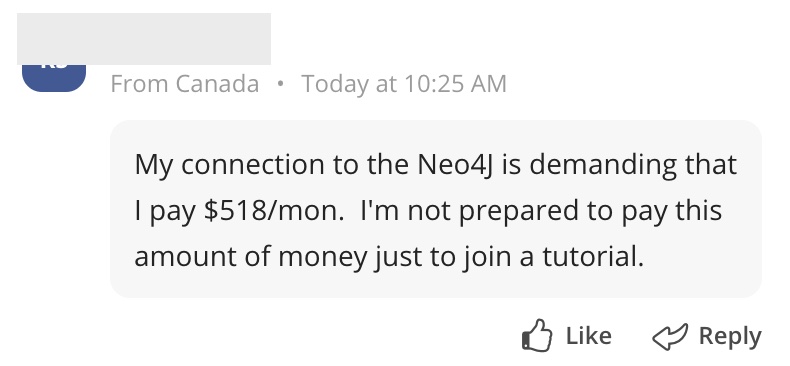
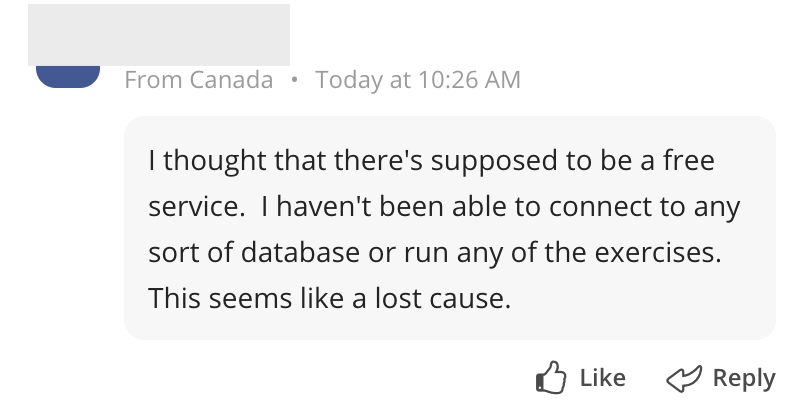


The presenter had clearly explained and demonstrated two free options for using the software at the beginning of the hands-on part, and the teaching assistants in the course had responded to every single one of the participant’s questions. And yet, he posted himself into a rage and acted like a complete ass. I can’t imagine that he’d act like that around his office – and if he did, I hope the company would tell him very clearly that’s not acceptable behavior.
(As an aside, another participant joined the live training 20 minutes before the end of the 2 hour session and demanded someone explain to them how to get started. The training was definitely interesting.)
Another example for interactions that are not necessarily disruptive but just look bad are folks asking for help in Slack channels. I just posted about this on Twitter a while ago:
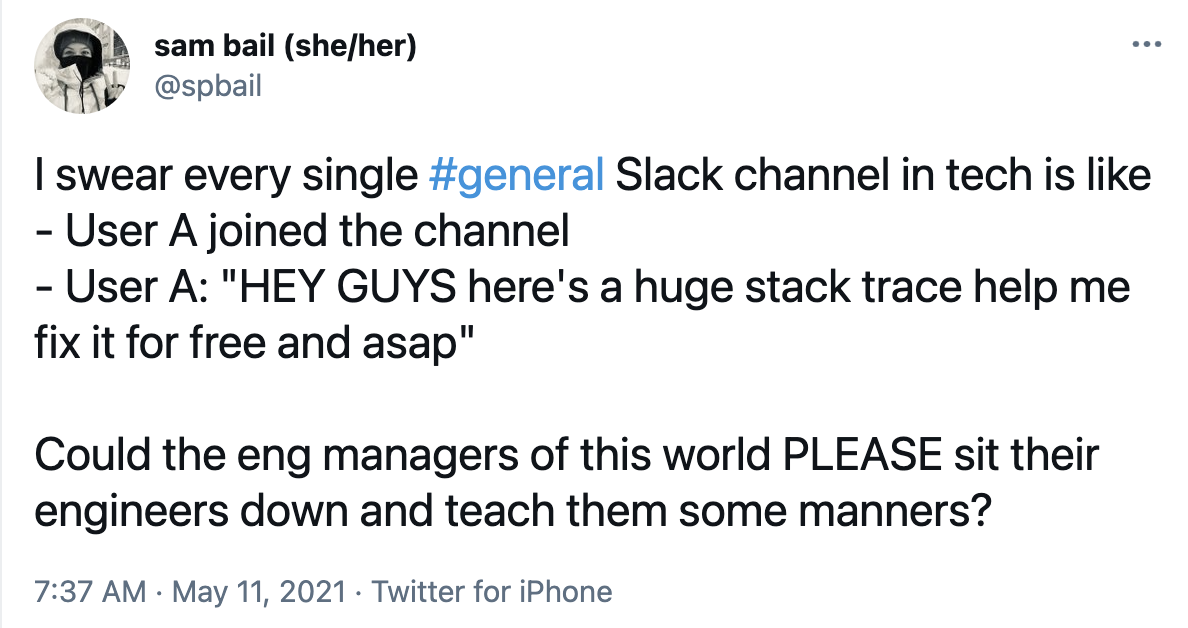
I’m in a quite a few tech Slack channels and I used to be a maintainer of an open source project, and the typical behavior I notice is:
- New user joins the channel
- Immediately posts a question asking for support, often dumping an entire error stack trace into the channel with no warning
- Frequently cross-posts the same question in other channels
- Occasionally posts several “anyone?” type follow-ups
- (Rarely) posts some annoyed or frustrated comment when they don’t receive help

Maybe I should care less about these kinds of things, but man, seeing this is annoying. I’ve muted most Slack channels I’m in because of too many Fremdscham-inducing interactions. Especially in open source communities, this sort of Kool Aid Man behavior (kicking down the virtual door but going “HELP ME” instead of “OH YEAH”, you get the idea) makes you wonder where people left their manners.
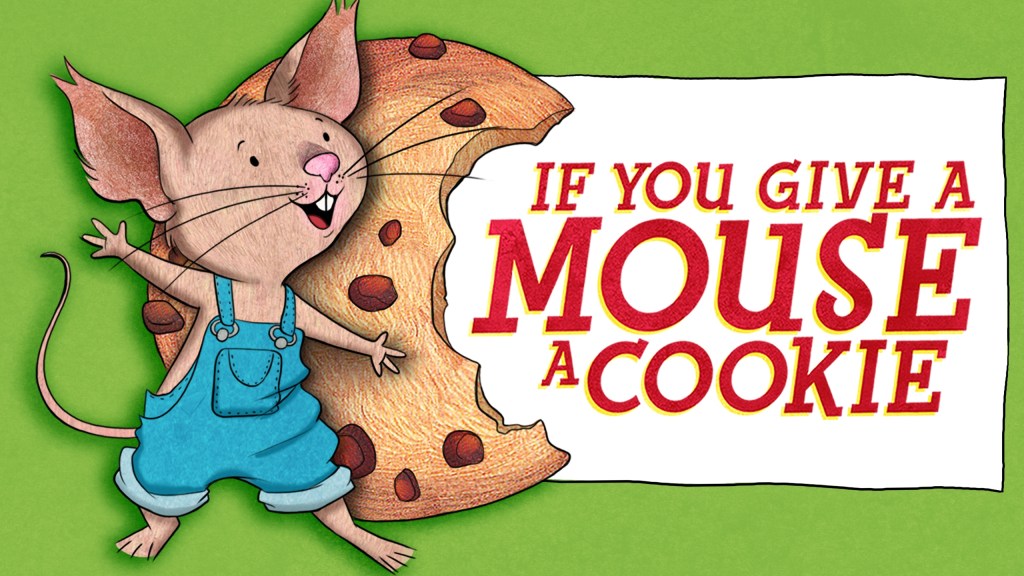
Another version of this is the “mouse asking for milk” behavior, which often follows Kool Aid Man behavior once someone receives help. For those that don’t know, the popular children’s book tells the story of a mouse that receives a cookie, then proceeds to ask for milk (to go with the cookie), a straw (to drink the milk), and other favors. This often has the effect of pressuring the helper to dedicate more time and implicitly puts the responsibility of solving the issue on them instead of the original question asker: “If you don’t continue to help me, you’re letting me down and I can’t solve this problem”.
Look, I understand that we’re all trying to get to results as quickly as possible. Fixing bugs and production fires, figuring out a configuration after banging our heads against the wall for hours, trying to get something to work while following along with a live instructor, all these things are annoying and stressful and make us impatient and want HELP. NOW. But we always have to keep in mind that the people on the receiving end are also just… people. Who are usually trying their best to be helpful, but they might have their own stressors, deadlines, time schedules to stick with, and might not have the capacity to drop everything and help. And maybe you’re the one who’s causing the thing to not work (if you’re in tech you’re guaranteed to have had that experience) – might be time to take a step back and take a break.
I’d also like to clarify that I’m not talking about obviously “bad” or illegal behavior. While many meetup groups, conferences, and open source projects have a Code of Conduct, most of the behavior I refer to is not necessarily a violation of a Code of Conduct, but just generally unpleasant. But keep in mind, just because it doesn’t go against any of the rules doesn’t mean it’s not disruptive, disrespectful, or just plain annoying to the organizers, presenters, volunteers, and other participants. And it makes you, and potentially the company you represent, look kinda bad.
How to not be “that person”
So here’s a thought for folks attending any kind of (virtual) events or participating in Slack communities, message boards, Reddit, GitHub conversations, and other communication channels. I don’t know if anyone’s reading this who should be reading this, but here we go. Before posting anything, ask yourself the following questions:
- Did I read the “welcome” message and instructions of where to post what?
- Am I posting in the right channel?
- Is my question clear and can people actually help me based on the information I’m providing?!
- Did I use the search functionality to try and see if this question was already answered?
- Am I asking an unpaid volunteer to do extra work? Have I already taken up a lot of their time?
- Am I being respectful and mindful of people’s time and other responsibilities?
- Would I post these kinds of things in my company chat, or say it out loud in a team meeting when my peers and managers are around?
- Can I wait until it’s a good time to ask that question?
And even after posting a question, there are some things you can do to make everyone’s life easier:
- Check whether someone actually answered the question, or asked for more details. Respond in a timely manner, or at least let them know that you will get back later.
- Said differently, pay attention and understand that if someone responds to you, they dedicated time to helping you. Be respectful of their efforts.
- If you don’t get the help you need, well, so be it. Unless you’re talking to the customer service of a service or product you pay for, you are not entitled to receiving any help, like, ever. And even if you’re paying for the service, keep in mind that customer service staff are humans you should treat with respect. Be persistent if you need to. But for goodness’ sake, please be nice.
- If the problem is resolved, post that you solved it and ideally, share your solution! This will help people later on, and lets people know that you no longer need help.
Tell your coworkers to not be “that person”
And for the managers out there: I know you’re not responsible for how your reports act outside of the work environment, unless that employee is explicitly there to represent your company. But we all know that the workplace implicitly extends beyond the boundaries of your company’s office, Slack, or email, and that employees are often seen as representing the company in the “outside world”, whether that’s good or bad. If your reports or coworkers (or managers…) behave disrespectful or somewhat disruptive (again, without necessarily violating any Code of Conduct) in an “extended work” setting, that’s just going to look bad and quite possibly make people question your company culture and what kind of people you hire. Well, it definitely makes me question what your company culture is like.
This isn’t an easy conversation to have, but I do believe that any company that onboards new employees likely shares (should be sharing?) some form of “rules” of communication, their company values, or other training that usually boils down to “don’t be rude“. It should be easy enough to include that this also applies to external venues such as (virtual) conferences, Slack channels, message boards, meetups, and other spaces in which the employee is present in a somewhat work-related context and may be seen as representing the company.
And for the presenters, maintainers, and volunteers out there…
Hey there, I see you. Well, I am you. I run workshops, teach coding classes, give conference talks, and help out in tech Slack channels. And I know that putting yourself out there and doing stuff out in public, whether that’s as a volunteer or part of your job, always comes with some amount of pressure and anxiety. Dealing with people who are rude or impatient is never pleasant. Here are some thoughts on how to help with this:
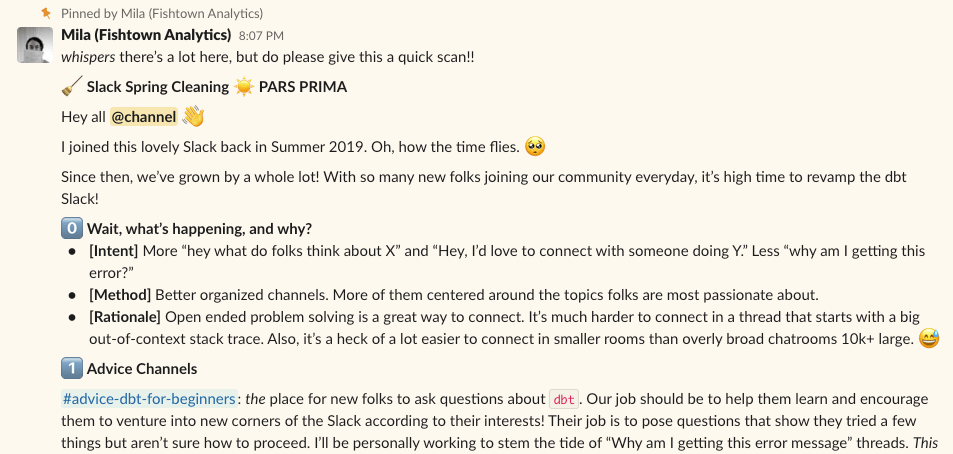
1. Set automated welcome messages in Slack and other communication channels explaining to folks where to post and how. Based on my experience, you can expect some proportion of people to actually read them, and some proportion of that to follow the rules. There will always be people who don’t pay attention, but you can make sure that the rules are actually enforced through gentle reminders: Ask your staff or volunteers to nudge people to post in the right channels, which (hopefully) also will be noticed by other members who will help with that. The dbt folks are pretty good at directing their Slack traffic to the right channels using welcome messages and periodical friendly reminders, see the screenshot below.
2. Add an “FAQ” page to your organization’s website. Reshama Shaikh, a data scientist who’s incredibly active in the NYC tech community I’ve been lucky to collaborate with for years now, recently pointed me to the FAQ page of Data Umbrella, a volunteer-led community group she founded. The FAQ cover a range of questions such as “can you give me career advice” and “can you help me find a job” and kindly point out that the group is entirely run by volunteers who give up their free time and pay out of their own pocket for any kind of expenses (such as MeetUp fees).
3. Have a slide on “How we communicate” rules at the beginning of a talk or workshop. In addition to highlighting the Code of Conduct, you can remind people when and how to ask questions, to use the search function, mention that the talk will be recorded and how the recording will be shared. If you have helpers or TA’s, ask them to enforce those rules, e.g. by posting reminders to hold questions, that the talk will be recorded, or links to the material.
4. Make technology work for you. Honestly, this might be a little dramatic, but see item #1 – there’s going to be a certain number of people who don’t read the rules. One way to make technology work for you, in addition to automated welcome messages, is to lock down the “general” Slack channel to allow only staff announcements, which is a good way to avoid the “new user support question dumping ground” effect. Another option to consider for any kind of live event is to only allow participants of a to join until a few minutes into the event, which avoids people not catching parts and then demanding help 45 minutes into a session.
5. It’s ok to not please everyone. I used to have the “will to please” like a freaking Golden Retriever. But you know what – it’s ok to say no, ignore people, or tell them to wait, for the sake of your own sanity. If someone comes into an event 30 minutes late and you’re a presenter or assistant already juggling several participants, well, maybe the person who came late simply won’t get lucky today and will have to figure things out themselves. Be kind, but firm, and let them know that you won’t be able to catch them up. Sorry. Likewise, if you’re helping someone out in a Slack channel and the mouse asks for more milk, it’s ok to let them know if you don’t have the capacity to help them any further… unless you are working in customer support of course and uh get paid to do exactly this. Otherwise, allow yourself to say no if this is turning from something you enjoy into a chore.
And finally…
I focused a lot on the “don’t make your company look bad” argument in this post, but I think it’s also important to point out that general kindness and respect towards people who dedicate their time to maintaining software, running workshops, giving talks or presentations, should be a given. Whether that’s paid or unpaid, we all need to consistently make an effort to see the person on the other side and man, just give em a break. Chill. Be nice. Accept the fact that sometimes you can’t have it your way. It’s ok. The world won’t end.





 Sam Bail
You must be logged in to post a comment.